Interview with Ava Hess
AMCA: Could you tell us about your research and what inspired you to focus on this particular topic? How does this paper fit into your broader project?
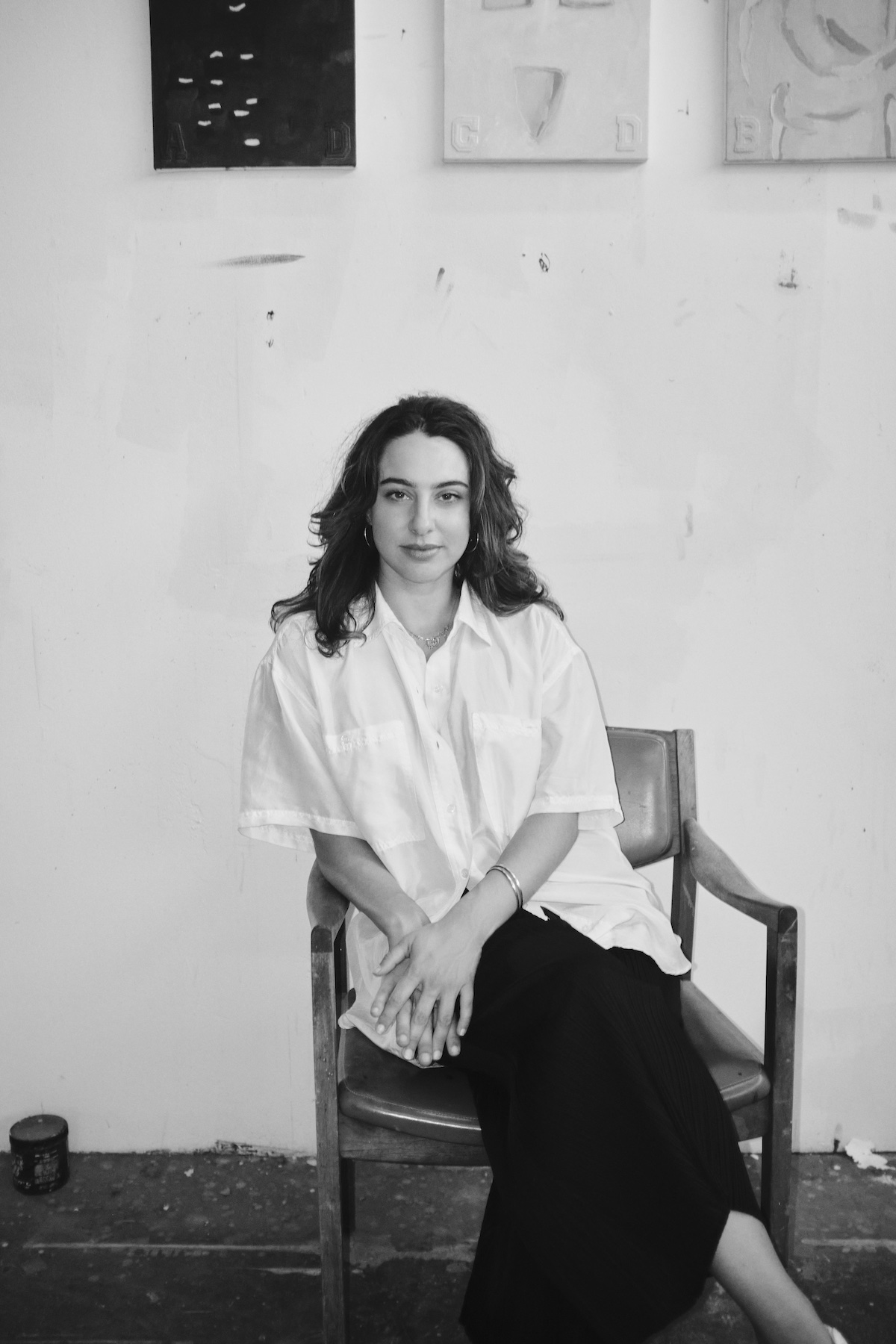
Photo: Stephen Aldahl
Growing up, I saw figural religious imagery—including popular paintings and posters of the Prophet Muhammad and other religious figures—as part of everyday life in Iran whenever visiting family. When I later learned of the supposed prohibition on figural representation in Islamic art, the tension between theory and lived experience became central to my scholarly work. I became interested in how figural traditions exist across the Islamic world, including in the Maghrib, a region not often associated with narrative art. Although my first encounter with the prints and reverse glass paintings that are the subject of my dissertation came during my undergraduate semester abroad in Rabat and Tunis, the actual seed for my dissertation emerged during a research fellowship at the Newark Museum in 2016 when I discovered a series of early-twentieth-century chromolithographic postcards from North Africa, filed not in the art collection but in the library archives. Their vivid illustrations of Islamic stories and figures defied expectations of Islamic art while also revealing how museum hierarchies often exclude the forms most widely circulated across the Muslim world.
My dissertation, tentatively titled Arts of Reversal: The Making of “Popular” Islamic Art in the Maghrib, examines chromolithographic prints and reverse glass paintings in Tunisia, Algeria, and Morocco from the nineteenth century to the present. It traces their historical production and circulation, as well as their colonial and postcolonial recuperations. This multi-sited project reconstitutes a vast corpus of vernacular, anonymously produced works with figural imagery drawn from Islamic history, epic poetry, and oral legend, dispersed across public and private collections in the Maghrib and representing a significant yet understudied dimension of modern Muslim visual culture. I study both mediums together not only because they share the same iconographic repertoire, but also similar processes of reversal in their production and parallel histories through which they became seen as “popular” art. I argue that the mobility and mutability of these prints and paintings was central to their widespread appeal and endurance; as the same scenes, motifs, and techniques were reused, adapted, and reinvented across contexts, their meaning was never fixed but continuously renegotiated.
The dissertation is grounded in long-term fieldwork: I was based in Tunisia from October 2023 to April 2025—supported by two U.S. Department of Education fellowships (Foreign Language and Area Studies followed by Fulbright-Hays)—and took numerous research trips to Algeria, Morocco, and France, both during that period and in the years before and after.
This particular paper grew out of a presentation for a conference on craft transmission and pedagogy at the Institut National d’Histoire de l’Art, held in Paris in December 2024, and has since developed into one of my dissertation chapters. It examines the history of the Markaz al-Funūn wa-l-Taqālīd al-Sha‘biyya / Centre des Arts et Traditions Populaires (CATP) in Tunis during the 1960s, which marked the first time reverse glass painting received sustained institutional attention in the region. It argues that the medium had previously been neglected because it fell outside the binary of beaux-arts (“fine arts”) and artisanat (“craft”) classifications inherited from the colonial period. The state’s institutionalization of “popular art” created a third space capable of accommodating a medium like peinture sous verre. And yet while the CATP extended the practice’s life through dedicating resources to its collection, preservation, scholarship, and revival among practicing artists, it simultaneously sought to fix the terms by which it could be understood and remembered—especially along lines that fit a convenient national narrative.
The chapter sits at a pivotal point in the dissertation’s chronological arc, as the first chapter to move into the post-independence period. Earlier, I trace the reverse glass painting’s development as a fixture of the domestic interiors of elite merchant patrons in nineteenth-century Sfax, and then the colonial-era print economy for Islamic images in early-twentieth-century Algiers, where commercial chromolithographs were co-produced by settler-owned presses and Muslim Algerian artists and employees, reaching a broad market before the same print material was mobilized for state propaganda during WWII. The CATP chapter is where the national state itself becomes the primary actor and is arguably where the dissertation’s larger argument about mobility and mutability comes into its sharpest institutional focus, since the CATP is the clearest case of a state apparatus recuperating this visual tradition and trying to fix it into a single, usable narrative. A last chapter follows the postcolonial avant-garde’s reactivation of the same figural repertoire found across earlier prints and glass paintings, especially in the cinema of the experimental Moroccan filmmaker Ahmed Bouanani.
AMCA: How do you situate your argument regarding the institutional framing of “popular art” in post-independence Tunisia within the larger field of modern and contemporary Arab art?
My argument here follows Stuart Hall in understanding “popular art” not as a stable category or fixed inventory of objects, but instead as a historically contingent and politically contested site of ongoing negotiation. The term “making” in my dissertation’s title plays on a double meaning, looking both at the material production of these works as well as their discursive invention as “popular”—particularly after independence, when governments and modern artists alike began collecting them and debating their role in nation-building.
In her 2019 book Mediating Museums: Exhibiting Material Culture in Tunisia (1881–2016), Virginie Rey uses the acronym MATP— Musée des Arts et Traditions Populaires —to describe a category of museums that began opening across the Arab world during decolonization and the emergence of postcolonial nationalism, many likely modeled loosely on Georges-Henri Rivière’s Musée National des Arts et Traditions Populaires in Paris. The CATP in Tunis, founded in 1965 as part of a broader restructuring of cultural institutions under Bourguiba, was just one instance of a wave of newly opened MATPs across the region.
My own paper examines one medium as a case study for understanding how this categorization unfolded in practice. Reverse glass painting—excluded from institutions like the Salon Tunisien or the École des Beaux-Arts, and never absorbed into the craft programs of the Office des Arts Indigènes—was too materially, iconographically, and historically hybrid to be seen as fitting a colonial imaginary of purity and revival. Through its new designation as a “popular” tradition under the CATP, the medium found value as part of the new nation’s anti-colonial search for an authentic Tunisian culture or “tunisianité,” which Rey, alongside Jessica Gerschultz and Alia Nakhli in their art historical scholarship on Tunisia, have all examined.
Scholarship on modern and contemporary Arab art has increasingly examined how newly independent states used cultural categorization (e.g. folk, popular, patrimony) to construct national legitimacy. As Hall (1981) reminds us, dominant culture continually seeks “to disorganise and reorganise popular culture,” to “enclose and confine its definitions and forms within a more inclusive range of dominant forms.” In post-independence Tunisia, this process unfolded through institutions like the CATP, which positioned itself against colonial hegemonies while constructing new ones of its own—classifying, narrating, and delimiting a medium whose own history sometimes sat at odds with the very category meant to preserve it.
The CATP increased public knowledge and interest in artistic practices like reverse glass painting by collecting, exhibiting, and interpreting them, but was never the only site of cultural negotiation. My dissertation puts this institutional story in dialogue with a broader field of Maghribi modernism by exploring how, from the 1950s onward, artists, filmmakers, and writers also engaged with the art of previous generations in ways that both converged with and diverged from the narratives of state-sponsored institutions. Avant-garde figures across the region turned to anonymously made, mass-circulated visual culture not merely to appropriate it as raw material for artistic experimentation, but also to intervene in the ways it circulated and actively contribute to its continued life. The dissertation’s final chapter looks to how some modern and contemporary artistic practices mobilize “popular” Islamic imagery in ways that keep it deliberately open to reinterpretation, citation, and historical layering—understanding inherited images as forms oriented less toward singular origins or stable meanings and more toward continual reuse and transformation, in contrast to state-led efforts to stabilize meaning through museums and heritage discourse.
AMCA: Your work recovers important artists and cultural figures, such as Khelifa Jelassi and Mohamed Masmoudi, who are less visible today. Who are they and why are they significant?
No single figure did more to secure reverse glass painting’s recognition in Tunisia than Mohamed Masmoudi (1934–2013). While serving as the CATP’s founding director from 1965-1972, he established important national collections of peinture sous verre both in Tunis and his native Sfax, published research and articles in the CATP’s bilingual journal Cahiers des arts et traditions populaires, and curated medium-specific exhibitions through the 1980s. His scholarship was also hands-on and he prioritized learning the technique himself. As his daughter told me in an interview, the only reverse glass paintings that remain in the Masmoudi family home today are ones her father painted, often replicas of works he had acquired for the nation’s collections, although a few are compositions of his own creation. A dedicated public servant, he never kept a single original for himself—a testament to his genuine belief in public collections.
Arguably, Masmoudi’s most significant contribution was his 1972 publication, La peinture sous verre en Tunisie, which is still to this day the only monograph published on the subject. In addition to proving foundational for any subsequent scholarship, including my own, the book was written for a general audience and widely distributed within Tunisia. In my dissertation, I try to show that it did more than merely document the medium: its many color reproductions effectively canonized a set of selected works, transforming CATP holdings into prototypes for future artistic production.
That’s where Khélifa Jelassi (1946–2009) comes in. One of the twentieth century’s most prolific reverse glass painters, Jelassi’s career began just around the time Masmoudi’s La peinture sous verre en Tunisie was published and his early work makes the book’s effect as a generative resource visible in a very direct way. He started out by restoring old glass paintings for the brocanteurs and antiques dealers of Tunis, who were likely responding to increased demand as the state began collecting the medium. His oeuvre includes numerous works based directly on historical examples reproduced in Masmoudi’s book, although over time and especially later in his career, he moved toward increasingly distinctive and experimental compositions of his own. Nothing, however, could secure Jelassi’s recognition as an “artist” among the capital’s contemporary art world, even if his paintings were bought and admired by figures associated with the École de Tunis who were well placed to grant him that status. His reception lays bare the persisting legacy of the “craft” versus “fine arts” binary that modernists and institutions like the CATP alike claimed to be moving beyond.
Masmoudi and Jelassi—two figures largely undocumented in English-language scholarship and invisible outside Tunisia—matter, in this case at least, for what they show about the CATP’s effect as a generative force, not merely an archival one. Masmoudi’s scholarship didn’t only help preserve reverse glass painting, it actively produced new practitioners through a visual canon for them to work from and eventually depart from. Jelassi’s own trajectory is living proof of an argument my dissertation makes about the medium as a whole: institutional recuperation extends a practice’s life while also setting the terms by which it’s understood and carried forward.
AMCA: One of the hallmarks of our field is the absence of centralized and/or public archives. What are the archives consulted for this study? What challenges have you faced in accessing them?
Within Tunisia, my research for this project centered on reconstituting the collections of the former CATP, which today fall under the purview of the Institut National du Patrimoine (INP). Gaining INP approval for access was, as expected, a lengthy process—but more complicated still was identifying where collections and archival materials were physically located because of how they had been dispersed (and continue to be transferred) across various governmental agencies and storage facilities since the CATP’s closure under Ben Ali in the 1990s. In Tunis, the CATP’s roughly 250 reverse glass paintings and related chromolithographic prints have recently moved from the beylical palace-museum of Ksar Saïd to a new climate-controlled depot near the National Library, intended eventually to offer researchers improved access. I also conducted research with the INP’s Dar Jellouli collections in Sfax, which has a smaller but very historically significant collection.
Unsurprisingly, reverse glass paintings are fragile and many of the works I examined in these collections showed signs of deterioration—broken panes, insects, encrusted dirt, flaking or peeling paint that sometimes rendered their compositions or inscriptions difficult to discern. I often had the sinking feeling that the very act of moving them for my research was contributing to their precarious material conditions. Compounding this is the institutional instability I witnessed across Tunisia’s public heritage sector, through unpredictable budget cuts and an erosion of institutional memory due to frequent restructuring and staff turnover. Despite the generosity of the individuals who supported my work, the CATP’s own institutional records remained unlocatable—a gap that has left many of these objects effectively severed from their supporting documentation.
I prioritized the CATP holdings specifically since they’re among the few that have been uniquely researched and, in some cases, dated—thanks again to Masmoudi’s dedicated scholarship—but the majority of my research was actually spent around private collections. Of these, the most significant belong to the artist, collector, and gallerist Ali Bellagha (1924-2006), the Eddar antique store and gallery (which holds the majority of Jelassi’s works), and Beit el Bennani—all located in or near the medina of Tunis. I also made many friends with shop-owners and antiques dealers, and visited the homes and private holdings of almost anyone I’d heard of with a significant sous verre collection. This mode of research looked very different, of course, from more traditional art historical research in museum collections or archives—one that involved a lot of time socializing and following threads from casual conversations or hearsay, more often reaching dead-ends but occasionally leading to very special finds and experiences.
Some of these research challenges are tied to the precarious institutional status of the artworks I study in Tunisia, while others point to something less specific to this project alone: gaps where the only surviving source is oral rather than documentary, unsigned and undated objects with no provenance paper trail, and tracking down contacts informally rather than through institutional channels. Archival accessibility is compounded, more broadly within our field, by the region’s colonial history. Beyond Tunisia’s own national archives, this paper references materials I found in the Archives nationales d’outre-mer (Aix-en-Provence), Centre des Archives diplomatiques de Nantes, Musée du quai Branly and Centre Pompidou in Paris, Musée des civilisations de l’Europe et de la Méditerranée (Marseille) and other collections across Europe, Algeria, Morocco, and Egypt—each holding fragments relevant to different threads of this history. There is no single centralized public archive for the subject of my dissertation, which is split instead across French colonial-administrative archives, European ethnographic and art museums, Tunisian state institutions, commercial markets, and private hands. In a way, this dispersal is itself evidence of the phenomenon I study in the paper, through a medium that circulated informally and was only belatedly and unevenly institutionalized.
AMCA: Tell us more about your research methodologies and your approaches to the images in your study.
Reverse glass paintings are still sold in Tunisian souqs today, though their smaller scale and new iconographies mark a clear departure from historical trends, often reflecting tourist market demand. Many Tunisians nonetheless recognize older examples from their grandparents’ homes, house-museums around the country, or the filmsets of directors like Férid Boughedir, where they are used to evoke the working-class Muslim interiors of Tunisia’s past. Alongside this nostalgia, I also encountered a casual distancing when these paintings are dismissed as foreign or “not really Tunisian”—attributed instead to external Shi’a, Turkish, or European influence, despite four centuries of continuous practice here. These cycles of disavowal and reclamation are part of why my dissertation takes a longue durée approach, tracing this arc across centuries rather than searching for singular origins, and treating meaning as something these objects continually renegotiate.
Existing scholarship on reverse glass painting—Masmoudi’s 1972 monograph, and those who followed him, but also folklorists and oral-tradition scholars working on Tunisia in the 1970s and 80s, including Micheline Galley, Abderrahmane Ayoub, and Bridget Connelly—did genuinely important and foundational work that I draw on throughout my own dissertation. But most of it also approached these paintings primarily as images, identifying their iconographic sources as illustrations of oral literature and epic legend. What can get lost in that approach is the object itself—how it was made, through what material process, how it moved.
My dissertation challenges the impulse to treat Maghribi prints and reverse glass paintings as a single, self-evident corpus on the basis of either shared iconography or a shared perception of their “folk” nature. So what warrants examining these artworks—chromolithographs and reverse glass paintings of wide-ranging but overlapping narrative scenes, non-figural compositions, and calligraphy—together in one study? Understanding a corpus as something continuously and actively constituted through practice and making, I propose an alternative framework for examining these works together as arts of reversal.
I approach reversal as both a technical and a conceptual process, one that shapes how these works repeat, circulate, and accrue layered meaning across materials, generations, geographies, and audiences. Reverse glass painting—also known as under-glass painting—requires applying paint to the underside of glass while chromolithography involves drawing images backward on a lithographic stone before each color is printed in sequence. In both cases, practitioners must execute the composition, figures, and text as the mirrored version of what the viewer will eventually see. This kind of production demands manual and cognitive dexterity from the maker, who has to hold two versions of the image in mind at once. Jennifer Roberts (2024) has argued that printmakers, through years of this practice, cultivate a kind of “reverse intelligence,” a tacit capacity to inhabit two orientations, two positions, at once; Giulia Paoletti (2023) writes that reverse glass painters also have to “familiarize themselves with the unfamiliar, becoming accustomed with the discomfort and the estrangement of imagining the world backwards.” In the colonial Maghrib, this capacity for a double orientation had real social and political stakes, allowing these works to speak simultaneously to different and unequally positioned publics, such as when the same scene might appear innocuous to European viewers but carry coded or affective significance for Muslim audiences.
Attention to a maneuver like reversal also points toward deeper continuities of visual-material practice in the region, rather than crediting European imperialism with introducing figurative representation or printmaking to North Africa. I trace my two core mediums back through earlier practices that rely on similar mirrored or reversed processes, including block-printed talismans, coin minting, and the mirrored constellation drawings in Islamic astronomical manuscripts such as al-Ṣūfī’s Book of Fixed Stars—situating nineteenth- and twentieth-century under-glass paintings and prints within a much longer regional history of image reproduction, rather than treating colonization as the starting point of the story. Taking an intermedial approach, I also situate both mediums within a wider field of image-making across northern Africa, including puppet theatre, calligraphy, tattoo design panels, murals, and more. My dissertation begins to extend this framework transregionally, following some of these images and techniques into West Africa, Europe, and Asia, in what I hope can be an opening for further comparative work in the field more broadly.
My project is grounded, too, in archival research and oral history—interviews, informal networks, family collections, even rumors and hearsay—methods that matter because working on mediums like these pushes back on assumptions often built into art history as a discipline: traceable authorship, a reliance on signed and dated objects, clear chains of attribution and provenance, and periodization assumed to be stable. Maghribi reverse glass paintings and prints rarely offer any of that. They ask us to take seriously different kinds of evidence that art history has traditionally treated as secondary, or merely supplementary to “real” documentary evidence—in turn challenging our discipline’s privileging of elite over non-elite production.